
By Chris Rennirt
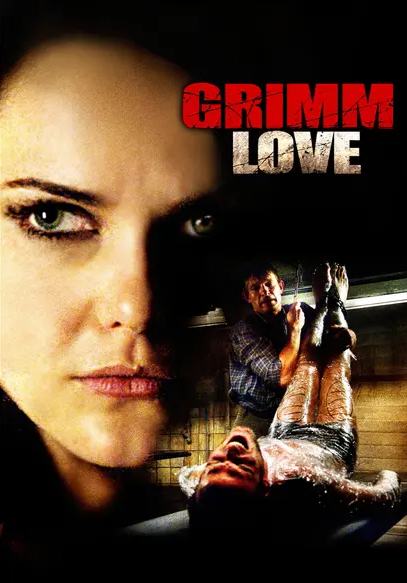 Imagine a movie about a man with a lifelong dream to be killed and eaten by another human, wanting the killer cannibal to first bite off his penis, fry it up, and serve it to him before being slaughtered! Imagine a movie as much about the life of the cannibal as the life of the cannibal’s willing victim. Before you say, “Hell yeah! Bring it on!” (Or hell no! That’s disgusting!”) also imagine that it’s based on a true story. With all this in your head, you’re now imagining the movie GRIMM LOVE (2006, written by T.S. Faull, directed by Martin Weisz), based on a true story of murder and cannibalism that occurred in Germany in 2001, as well as one of the most shocking criminal cases in German history. For all the horror lovers out there, how much better does it get than a movie about real-life horror and real-world, human monsters, not of the usual fictional tropes and cliches? Not much…usually! But with Grimm Love?
For more of the movie’s factual basis first, let’s start with Armin Meiwes, the 42-year-old computer technician from Rohtenburg, Germany, and the first in the film’s main-character duo. It was Meiwes who started it all by posting an online advertisement on a cannibalism forum titled “Dinner – or your dinner”, seeking a “young, well-built man willing to be slaughtered and eaten.” The cannibal’s victim and food “Bernd Juergen Brandes, a 43-year-old Berlin engineer, answered Meiwes’ advertisement, volunteering to be killed and eaten. The two met at Meiwes’s home on March 9, 2001. There, after various sexual acts, Brandes took 20 sleeping tablets and half a bottle of schnapps. With Brandes’ consent, Meiwes amputated Brandes’ penis–by first attempting to bite it off–and fried it for both to eat.” Afterwards, Meiwes stabbed Brandes in the neck, butchered his body and ate nearly 20 kilograms of his flesh over the following 10 months. The flesh was described by Meiwes as tasting “like pork but stronger.” He later claimed that the whole experience was the fulfillment of a fantasy he had longed for since childhood. (Holy shit!) To cover himself for foreseeable legalities, Meiwes filmed the entire cannibalistic procedure, as proof of Brandes’ consent. (And that, in this whole tale of carnal craziness, is the only thing that actually makes sense!)

While those are the facts in the case, are they the contents of the movie and its plot so succinctly told? Yes, mostly, as far as I know, with lots more added or altered, for better or worse. While I don’t know all the creative liberties taken, especially with childhood histories of the cannibal and victim, I know the names of the two were changed, possibly for legal reasons. The actual cannibal’s name, Armin Meiwes, was changed to Oliver Hartwin (played by Thomas Kretschmann), and the actual victim’s name, Bernd Juergen Brandes, was changed to Simon Grombeck (played by Thomas Huber).
To continue with what’s “worse,” Grimm Love (also titled Rohtenburg, after the city where the murder occurred) has an annoyingly unnecessary wrap-around plot, featuring the movie’s token star, Keri Russell (as Katie Armstrong). While I understand the vehicle it (the side plot) and she (the side character) provide for the storytelling, they are both more of a distraction than anything useful. They also seem more of a way to feature a well-known American actress in a foreign film, for U.S. marketing purposes only. Russell plays an American college student in Germany conveniently–and contrivedly–studying the psychologically deviant subject of cannibalism, who becomes obsessed with what is arguably the arch case for study, as well as the case of the movie’s study–The Brandes Meiwes Case. Consequently, and to further the movie’s plot and narrative, she proceeds to do various investigative things, often stupidly and recklessly, to set viewers up for the various glimpses into the past that tells the story. Her visits to the childhood homes of Meiwes and Brandes morph into scenes from their childhood, showing what twisted their minds at an early age, making them the monsters and/or victims they became. Russell unbelievably and too easily obtains a copy of the very tape of the murder recorded by Meiwes, delivered to her door, not long after making contact with someone on the same cannibalism website used by Meiwes. How lucky is that? Worst of all about Russel’s character and her role as a prominent actress is how throwaway it all is, as an undeveloped character that no one really knows or cares about. She mostly just adds filler material to make the movie feature length. By eliminating the tacked-on, wrap-around plot with Russell, at least half of the movie could have been excised, without losing anything. Even moments Russell’s character is possibly threatened by a knock at the door at night fall flat. Why? No one cares. Amazingly, I even read that more scenes with Russell were filmed and later cut. Do I wonder why? Not really. More about that later!
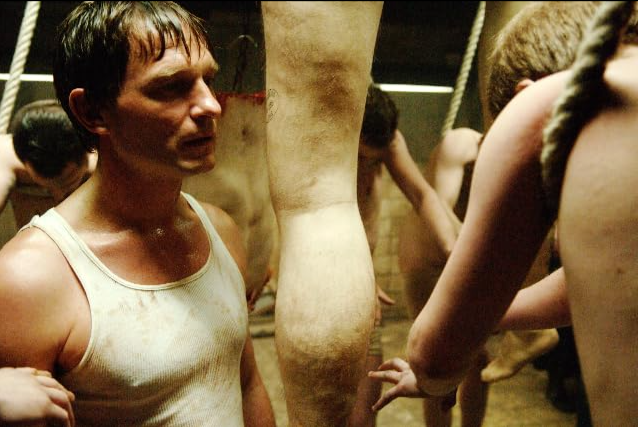
What’s worse is that even what’s better about Grimm Love ends with more of what’s worse. The best (in a best horror film way) is the story, at its core, of a real cannibal eating another human who not only consented to the act but also longed for it since childhood. The reminder of real-world horrors and real-world monsters is bold and terrifying, all the more so with a true story–with a victim who is perhaps as much of a monster wanting to be eaten as the cannibal is a monster for eating him. What’s better, but not the best? The acting of all involved is well done, convincing, suspending disbelief throughout. Keri Russell, Thomas Kretschmann, and Thomas Huber all transcend the movie’s lower-budget shortcomings, with performances making it the best it can be. While no performance is outstanding, it is mostly because no role seems written to be outstanding. Keri Russell has the most difficult role, making something remotely memorable of a hopelessly throwaway character.
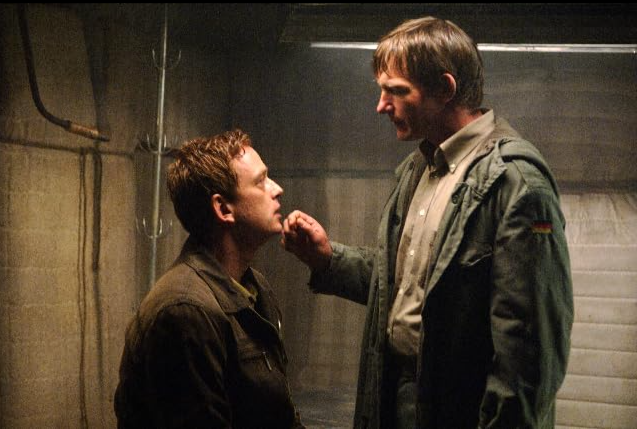
Testing patience more is the slowest of slow burning plots, plodding along with a story seeming twice its running time. However, for the last of its “better” qualities, it keeps viewer attention until the end, somehow, even if we check time along the way. But is Grimm Love a movie for second viewings, for those who like collecting and rewatching. No. With its slow, predictable plot–and after knowing the undelivered gore of the real story–it has nothing to tempt a second viewing. All of the violence is off camera, there is minimal blood, next to no action, and nothing is visually (or performatively) memorable. While more can be less in some films, less is less in Grimm Love. With so much to offer as a true story, with so much factual potential for violence and blood, too much is left out–too much that could have made it better. It could have at least been one to watch again for its excesses. Many a great cult film is all about that alone. Instead, a movie about Germany’s most notorious criminal case is a movie we forget.
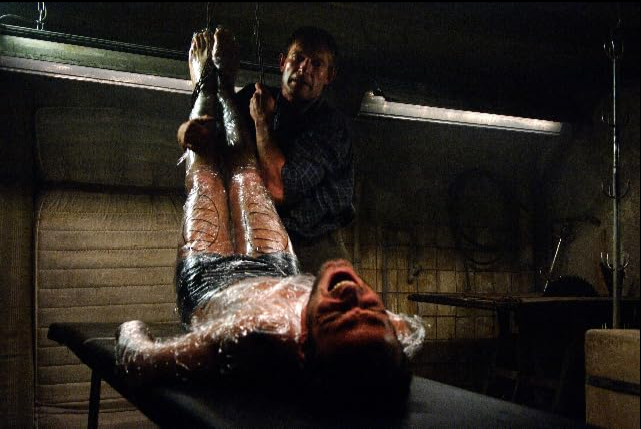
What’s worse (yes, there’s more) is how the film’s DVD/Bluray art and posters falsely suggest the kind of gratuitous, albeit true violence it doesn’t deliver. The back of the DVD cover shows a bound man in pain being hoisted up by his feet, by the movie’s flesh-eating villain. While this scene appears in the movie, it is nowhere near what the image suggests, deceptively so. Even for marketing purposes, they know that what the movie lacks is exactly what it needs to attract an audience. Here, the producers of the movie are effectively admitting its deficiencies, deceptively attempting to compensate.
Interestingly, not worse, is the movie’s alternate release title, Rohtenburg. With that, it is simply named after the German city in which the murder occurred. I prefer Grimm Love, even though it makes the movie no better. What it does do is allude, obviously, to the Grimm of Grimm’s Fairy Tales from The Brothers Grimm. The reference to the bizarre, often violent nature of original fairy tales is more appropriately ominous than the simple name of the city where it happened. At least Grimm Love means something that relates to the movie and its ironic horror.
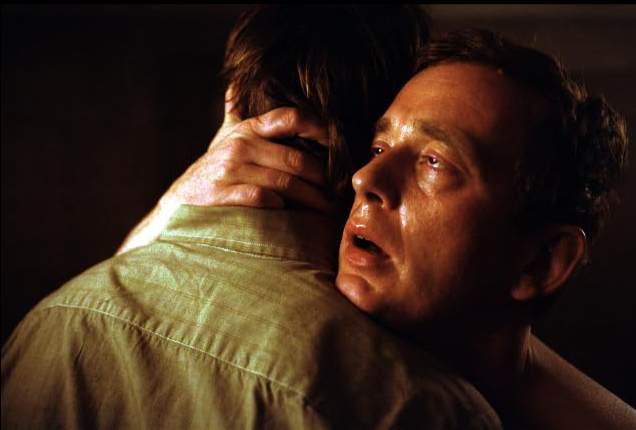
“What was the legal outcome of all of this, with the real story, in the real world?” you ask. The real cannibal, Armin Meiwes, was initially convicted of manslaughter in 2004 and sentenced to eight years in prison. However, Meiwes was retried in 2006, with the court ruling that even consent could not legalize cannibalism. As a result, he was sentenced to life imprisonment. Although German law at the time did not criminalize cannibalism, Meiwes was charged with murder for sexual pleasure and disturbing the peace of the dead. And none of this is in the movie.
And what more is there about the dreaded, half-baked side plot with Keri Russell’s character, Katie Armstrong? It’s more like what’s more about what more could have been. According to easy-to-find information via Google AI, the Katie Armstong character originally had a much larger role that was drastically reduced in the editing room. Director Martin Weisz confirmed that over 20 minutes of her footage was cut from the final version of the movie. The removed material included an entire subplot featuring a boyfriend for her character. The filmmakers decided to make the cuts to shift the primary focus back to the two male characters, Oliver Hartwin and Simon Grombeck, rather than the framing of Katie doing her thesis research. And this all leads me to the final of the few better things about the movie. They at least removed half the Katie Armstrong footage, making the movie only half as bad as it might have been…I suppose. But, in the end, the half that remains is still too much!

In conclusion, Grimm Love is a disappointing, half-baked effort to tell a story with much more story to tell…and show. Perhaps it’s also, to use a fitting metaphor, much like the half-bitten, disappointingly tough, fried penis of a would-be horror classic. Just sticking to more facts from the case would have made it better than it is, with a little more blood and gore from the real story as visuals. Am I saying we needed to see Oliver actually bite into Simon’s penis? No! Am I saying we needed to see more of the over-fried, disappointingly tough member, charred on the plate, in front of Simon, nearly crying because the moment is not “perfect”? Of course not! Am I saying that we needed to see Simon stabbed, gutted, slaughtered, and bled dry, later cooked with potatoes and sprouts, served on Meiwes finest dinnerware, along with is penis? Hell no! (Or maybe hell no!) But a somewhat spicier sausage may have been a more palatable delicacy for my taste…in horror, metaphorically, of course!

Rocket Rating – 5
Chris Rennirt is a movie critic and writer in Louisville, Kentucky, as well as editor in chief at Space Jockey Reviews. He has been a judge at many film festivals, including Macabre Faire Film Festival and Crimson Screen Film Fest, and he attends horror and sci-fi conventions often. Chris’ movie reviews, articles, and interviews appear in Effective Magazine and are published regularly on Space Jockey Reviews.