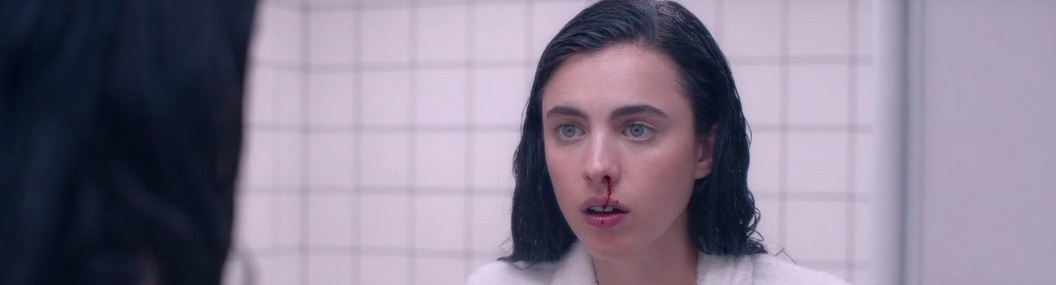
Review by Chris Rennirt
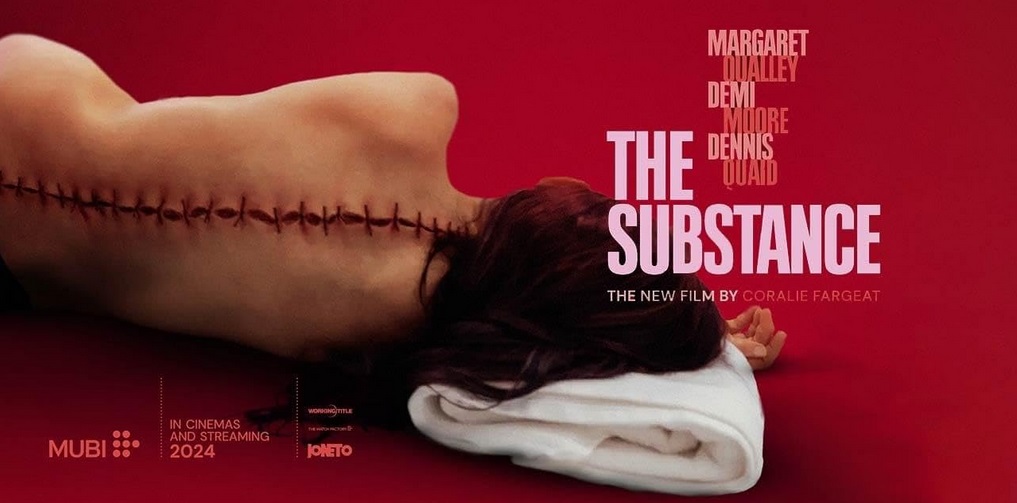
On her 50th birthday, faded celebrity Elizabeth Sparkle (Demi Moore) is fired from her long-running aerobics TV show, because, as her producer Harvey (Dennis Quaid) informs her, she’s “too old.” Devastated and desperate, Elizabeth calls to acquire a black-market drug (“the substance”) that is advertised to produce a “younger, more beautiful, more perfect version of yourself.” Thus begins the most beautifully-disturbing, mind-fucking masterpiece of body-horror cinema ever produced, as well as what is easily the best horror film of 2024–and possibly the best film of the year in any genre!

Demi Moore (as Elizabeth Sparkle) in The Substance
The Substance (directed by Coralie Fargeat) is a movie with countless outstanding qualities to cover in a review. For me, deciding where to start is done as well by rolling the dice, as by trying to order them in any way. A first, most-striking feature of The Substance, in addition to its extreme horror, is its payload of metaphors, references, and meanings below the surface. If there was an Academy Award for “Best, Most Comprehensive Metaphors in a Film,” The Substance would be a winner, indeed! Nothing goes to waste here as just coincidence without meaning. Colors, fashions, character types, set and creature designs, camera angles, select focusing, the movie title, and much more have layers of purpose far below the surface. As for the title, it’s an obvious reference to a substance as a drug, emphasizing the physical and psychological horrors of addiction. With another definition of substance–“the quality of being important, valid or significant,”–it further suggests the value assigned to others by society (in this case, based on superficial qualities), as well as subjective public esteem which individuals further assign to themselves. As for the film being “beautiful” (as I mentioned earlier), it really is! As a work of cinematic aesthetics, bold, bright, vibrant colors resonate visually, emphasizing their analogies and subtexts. Bright, ultra-clean colors and sets deliver stark, opulent impact against the film’s extreme gore, with mutually-enhancing effects. The neon-green of the “The Activator” warns with its color, with references to the Re-Agent in Re-Animator. Even the use of a pee-yellow coat is symbolic, as it is worn and later not worn. I even suspect the producer’s name, Harvey, to be a reference to the now infamous, incarcerated Harvey Weinstein. Aforementioned social commentary about commercial, societal, and male-defined female beauty are amplified and horrified, as they dominate and destroy self-esteems and self-images. Here, we could even coin a new genre–societal horror! Detailing the film’s countless references, metaphors and analogies would be a great subject for a film analysis (and trust me, there are more!). For anyone interested, Emma Wolfe does an unbeatable job of this in her analysis of The Substance on her YouTube channel, Spooky Astronauts.
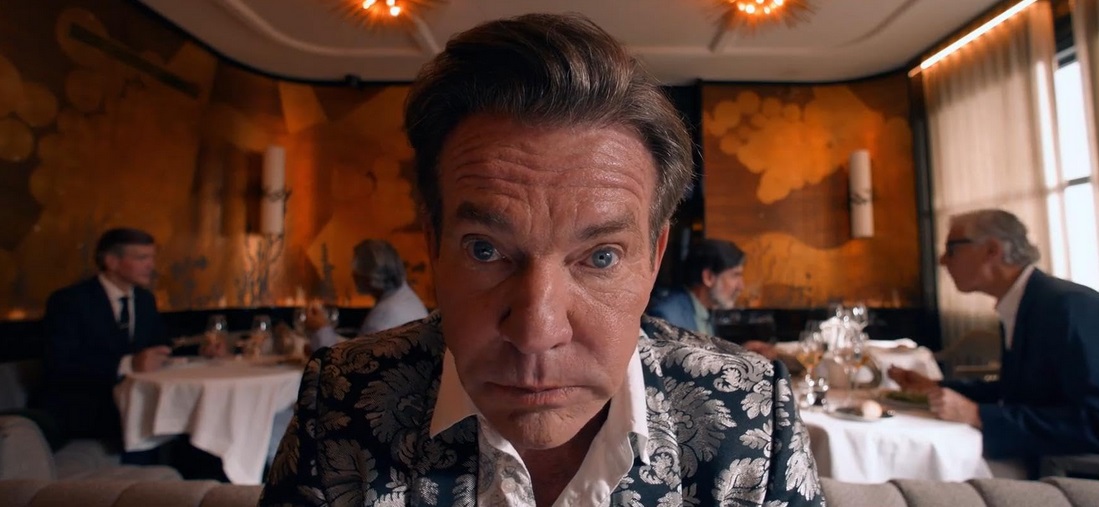
Dennis Quaid (as Harvey) in distorted, wide angle!
As for acting, Demi Moore’s performance as Elizabeth Sparkle is her best ever! Moore’s a great actress in general, and she’s been great in other films. But, in my opinion, her performance here tops everything! Like the saying in the movie, “Remember you are one,” Demi Moore becomes Elizabeth Sparkle, as “one” capturing every nuance of her character–her emotions, pensive expressions, anger, and more, sometimes without saying a word. Dennis Quaid delivers a slam dunk performance as the vulgar, sexist producer and effective villain of the story, as the perfect dark-comedy caricature of his stereotype. Almost sounding like an insult (while really the greatest compliment), I can’t imagine anyone else doing a better job than Dennis Quaid. The range of his masterful acting is on full display here! And, as with Moore, I would also call this Quaid’s best performance ever. While I can’t talk about the specific role of Margaret Qualley without adding spoilers, her crucial performance as Sue flawlessly matches the strength of her costars. At the risk of sounding partially sexist (which I’m NOT), she’s a fresh, beautiful, ultra-expressive, full-spectrum actress, and with all of that, exactly what the movie needs! (You’ll see what I mean!) With Qualley, Quaid, and Moore, The Substance achieves a trifecta of outstanding acting, without which the movie could never be such a masterpiece!
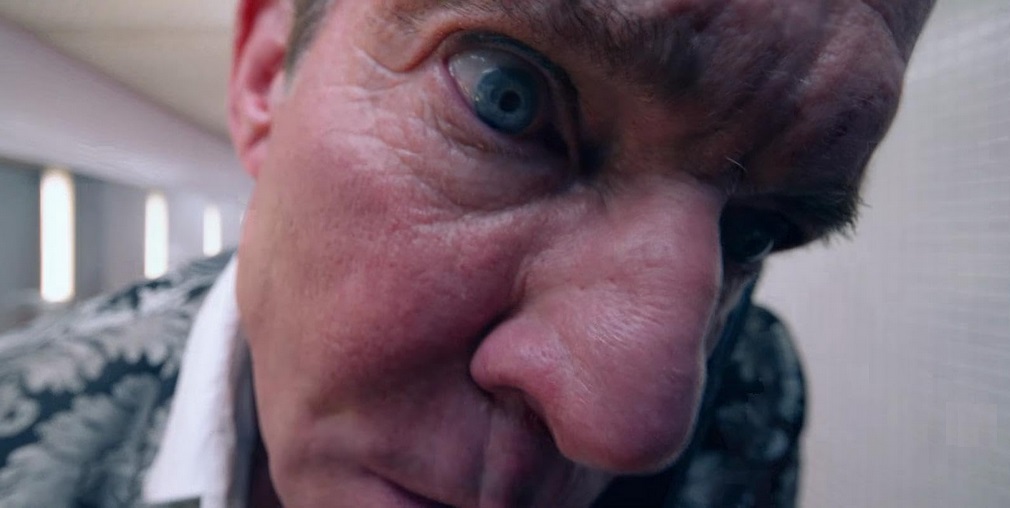
Disgustingly up close and personal with Harvey (Dennis Quaid)
Supporting the “the trifecta,” of outstanding actors is a script with every word and every scene integral; making us want more, it fascinates, outdoes itself again and again, going beyond one extreme, and on to the next. Each time I thought, “Wow! It can’t go any further than this,” it did, every time. Even with the long running time of 140 minutes, it moves along efficiently, void of excess and banality, never-slow burning, never causing the dreaded time check. Better yet, even as things become more surrealistic, it never goes beyond a boundary that seems impossible or unbelievable, within the world it creates. Here, even the unbelievable becomes believable, or at least not an issue. As an example, there’s a brief WTF moment of objective realism (or subjective surrealism) I’ll cryptically call “Finding Extra Room,” to avoid a spoiler.

Demi Moore (as Elizabeth Sparkle)
Of course, the best of body horror must use practical effects, mostly if not entirely. Thankfully, The Substance does not skip here in content or quality. Prosthetics and old-school effects here are among the best I’ve ever seen in a movie (if not THE best)–and that’s saying a lot! Digital effects are used mainly to enhance the physical props, rather than to replace them. And anywhere this occurs, it is seamless–so much so that I can’t be sure when and where it is used! As any veteran horror fan knows, digital effects often, even now with advancements, create organic images too perfect and slick in appearance, losing textures that real organic material should have. To the limited extent that digital effects are used in The Substance, no such loses occur.

A sensual, aerobically-fit Margaret Qualley (as Sue)
As for sound design, the film score was conceived by British producer and composer Benjamin Stefanksi, better known by his stage name Raffertie. And what a masterpiece of electronic music it is, mirroring with tonal metaphors the duality of personas found in Elizabeth and a physical alter ego. It’s a score that does more than punctuate suspense and horror as most do at minimum. Additionally, it works with the story to define characters, as characters define themselves. Again referring to the story’s tagline, the score becomes “one” with the characters it musically defines. And with that, I’ll stop again to avoid a spoiler!
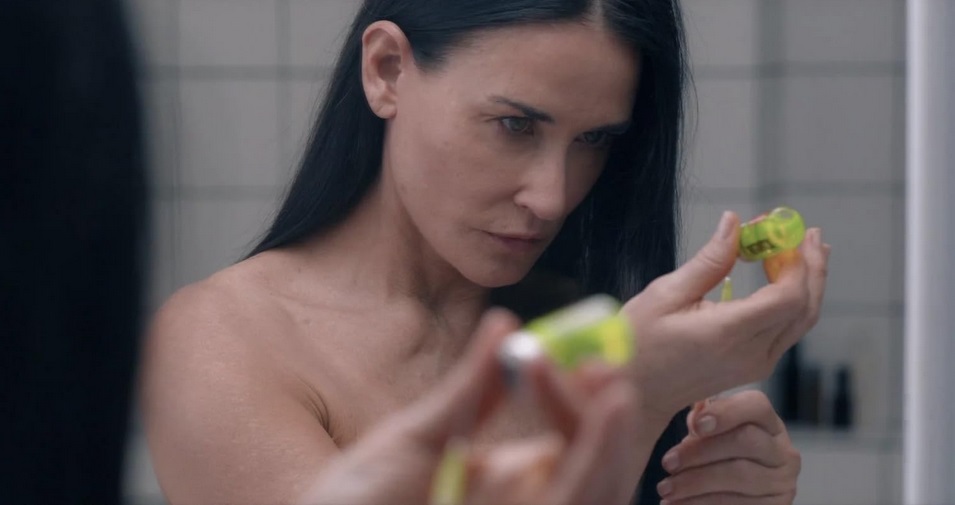
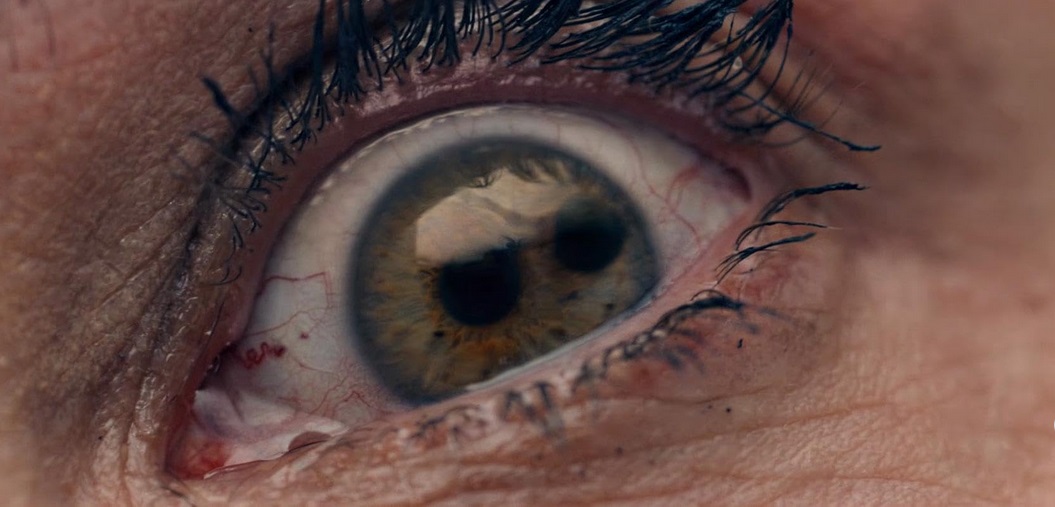
The Substance is also in a sub-genre I call macro horror–a technique of cinematography showing details of horror up close, at high magnification, sometimes even on a microscopic or cellular level. This has the effect of amplifying the visceral, organic details of flesh, blood, organs, and gore, creating a more terrifying reality, literally in the viewers face. Close-ups of eyes–even the normal ones–were remarkable and unsettling, while still familiar to us as humans. Close-ups of Harvey’s face and mouth, close enough to see his wrinkles and the grime between his teeth, were horrific, while again being totally human. Many close-ups also used a wide angle lens that distorted faces (yes, particularly Harvey’s), making them more grotesque and monstrous, as a visual metaphor for their character. Such effective close-ups are used by director Coralie Fargeat to focus viewer attention exactly where she wants it, with a most effective, horrific result, both surreal and, ironically, ultra-real.

A bleeding Sue (Margaret Qualley) in The Substance
Also most effective is how the movie uses humor (pitch-black dark as it is) as a contrast to the film’s graphic horror, extreme gore and human suffering. The contrast blends perfectly, amplifying it all even more, as viewers ironically laugh (within, if not out loud) at what is horrific. Seeing a pig like Harvey, up-close with wide-angle distortion and gross detail, revealing his own monstrous nature, is both physically horrific and vengefully humorous. A perfect, dark-comedy success it is! This and other intentional humor makes the film self-aware and successful at its purpose, as audiences laugh with its comedy, rather than at it.

And is The Substance inspired by other ground-breaking body horror before it? Yes! As with other exceptional recent entries (like Together, 2025), there are many likely muses: John Carpenter’s The Thing (1982), David Cronenberg’s The Fly (1986), and Brian Yuzna’s Society (1989) are just a few that come to mind. However, what’s sensational again is how Coralie Fargeat uses inspirations (or homages) as only a catharsis for a totally new, jaw-droppingly original mindfuck of a movie! (And yes! This is a film that requires repeated profanity to describe it!) As a fan of extreme body horror myself, always reminded of the classics, I see The Substance itself as the creative engine for many body-horror films in the future…and a new classic on its own!
Backing up my Best Horror Film of the Year award for The Substance are many other agreements on the world stage. It received the award for “Best Screenplay” at the 2024 Cannes Film Festival, and five Academy Award nominations: Best Picture, Best Director (Coralie Fargeat), Best Original Screenplay (Coralie Fargeat), and Best Actress (Demi Moore). And, keeping with my opinion of Moore’s stellar performance, she won a Golden Globe Award for “Best Actress” in the film. She said herself, in her acceptance speech for the award, “I’ve been doing this a long time, like, over 45 years, and this is the first time I’ve ever won anything as an actor. I am just so humbled and grateful.” And, indeed, we–at least the horror fans among us–are so humbled and grateful to experience such a performance! My only complaint is that Moore and the movie should have won more of the awards for which it was nominated! But, asking more from the high-brow academies of “Motion Picture Sciences” is, perhaps, more surrealistic than The Substance.
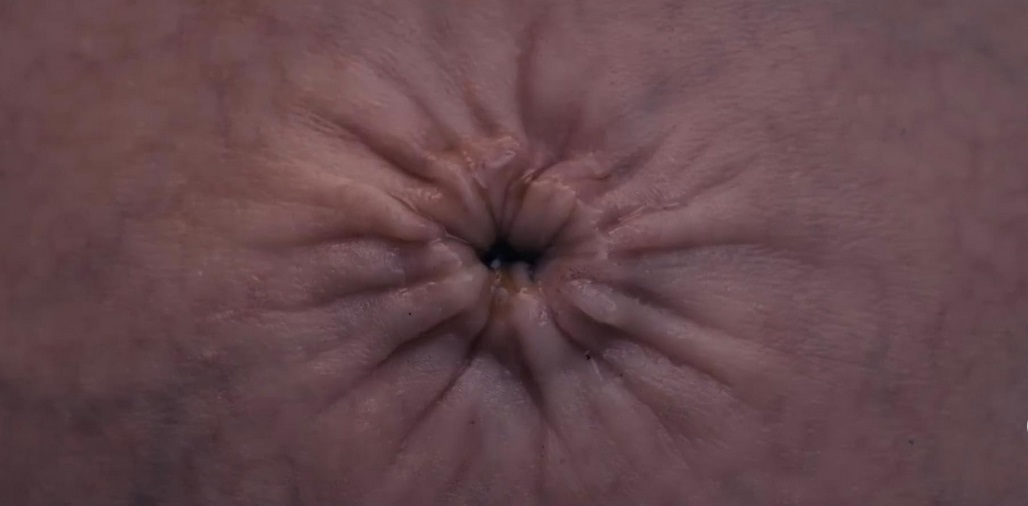
What could this puckered orifice possibly be?
As always, there are questions. What will happen to Elizabeth when she uses “the substance”? (Yes, I’ve been very careful not to tell you that!) Will she find the happiness she seeks or find something far worse than being 50 years old and out of a job? Will Harvey get what he deserves in the end (whatever that is)…and will he ever clean his teeth? Will Demi Moore and Dennis Quaid ever make another movie with better performances? Will another body horror movie ever outdo The Substance? And what, for the love of God, is that puckered, fleshy orifice in the screenshot above?

In conclusion, for fans of ground-breaking horror, I cannot recommend The Substance enough. More than intelligent, it’s a genius-level work of deeper meaning, metaphors, and higher levels of thinking rarely seen in horror, especially with genres so extreme. A jaw-droppingly original mindfuck of a movie it is (and yes, I said it again)! If you’ve the brain for it–and the stomach for it–look for The Substance as fast as an addict looks for a fix. But be careful! If you’re like Elizabeth (and me), you might just get addicted!

Rocket Rating – 10
Chris Rennirt is a movie critic and writer in Louisville, Kentucky, as well as editor in chief at Space Jockey Reviews. He has been a judge at many film festivals, including Macabre Faire Film Festival and Crimson Screen Film Fest, and he attends horror and sci-fi conventions often. Chris’ movie reviews, articles, and interviews appear in Effective Magazine and are published regularly on Space Jockey Reviews.