Review by Chris Rennirt
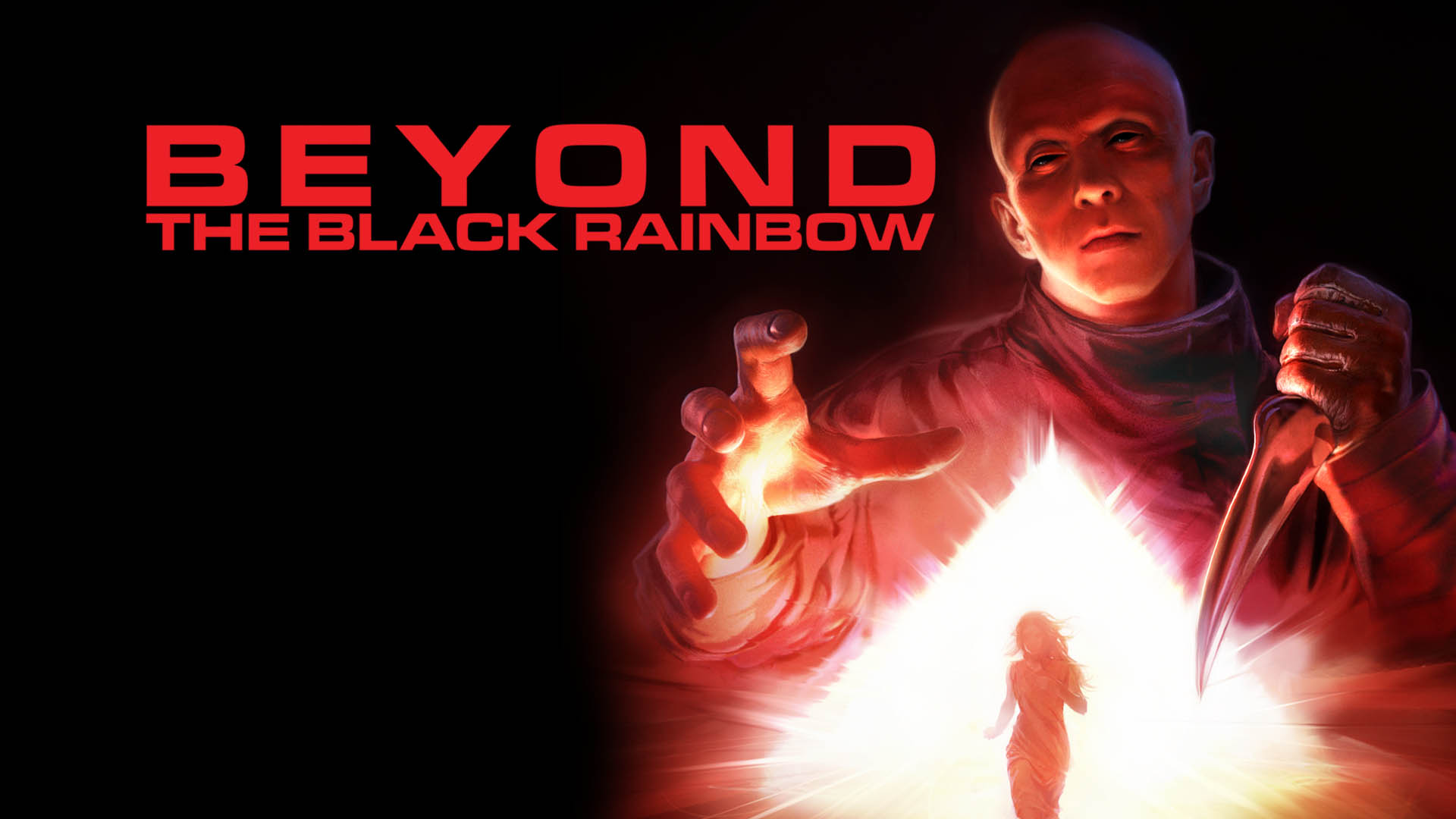
If you’ve ever wanted to take an an acid trip without taking the drugs, Beyond the Black Rainbow might be a movie for you, as well as a safe alternative, even if it’s not a movie for anything else. A striking, dreamlike visual style with an ultra slow-burn pace and bold hypnotic colors saturating the screen make up for a lack of more traditional movie substance–a plot, well-developed characters, a coherent story, etc. Some have described it as a “trance film” or a “retro sci-fi head-trip,” leaving more questions unanswered than answered, and I totally agree! And what a refreshing departure it is from “the usual.”

What’s it all about? Don’t worry! The most I can tell you won’t really give anything away. The plot (or what there is of it) centers around a young mostly-mute woman named Elena. She has psychic abilities and is held captive in a secluded, futuristic facility called the Arboria Institute. It’s a research facility that is, at least as a front for it’s more sinister purposes, said to be a place that helps one achieve “Serenity Through Technology.” The head of the institute is the deranged Dr. Barry Nyle (Michael J Rogers) who experiments on Elena in order to exploit her psychic powers. The story involves the increasingly obsessed behavior of Dr. Nyle, as he becomes more unhinged from his own drug use, research, and plans for Elena.
“The trappings of the mortal world are…but a distraction, wouldn’t you say?” ~ Dr. Mercurio Arboria
And when I said the movie is a “slow-burn” earlier, I must exaggerate. Beyond the Black Rainbow (written and directed by Panos Cosmatos) is, in fact, one of THE MOST slow burning movies I’ve ever seen. It’s possibly what I would even call a “smoldering” movie, not even burning. Is that a bad thing? Not necessarily, depending on your patience, your interest in a very different type of movie, and how much you truly enjoy reading between the lines, filling in what’s missing. Free thinkers, retro sci-fi junkies, and lovers of the 1980s may be in movie heaven! Other slow burning to smoldering classics I love include Solaris (1972, directed by Andrei Tarkovsky) and, of course, 2001: A Space Odyssey (1968, directed by Stanley Kubrik). While those are not so missing in essential elements, they certainly prove the power that slow pacing can have, when it is used intentionally, with purpose and success. Beyond the Black Rainbow does it with success, as it gives us time to focus on and absorb the dreamlike world in which it occurs. It also allows time to find meaning, even if there is none, within its drug-induced, psychedelic landscape.
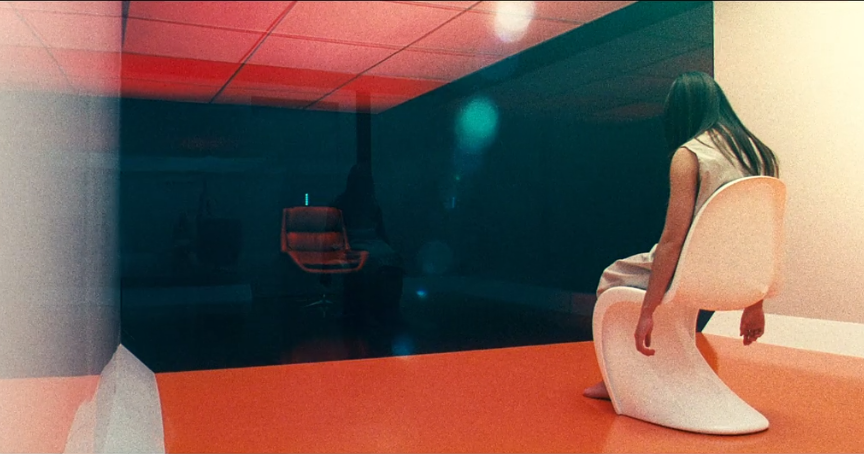
The movie is also in the genre of what I call cosmic horror. References to god (in a more cosmic sense) and otherworldly, inter-dimensional visions are elements of the cosmos, or the universe as a whole. Horror occurs within these cosmic places. The unpredictability and mystery of the horror maximizes its effect all the more, in both the cosmic world we don’t know and the terrestrial world we know…or think we know. Horror in unknown places is horror at its finest! Other, slow burning cosmic-horror films in the genre include The Void (2016) and Color Out of Space (2019), both adapted from the works of H.P. Lovecraft. Adding to Beyond the Black Rainbow‘s impact is the way director Panos Cosmatos makes the horrors unpredictable and oppositional in their presence; some are only heard off screen, others are surprisingly on screen and graphic, while others are a teasing mix of the two–a bold, chaotic combination of fear, mystery, and otherworldly horrors!
“I went to another world, Rosemary. I see what others cannot see. I looked into the eyes of god.” ~ Dr. Nyle
The soundtrack is a haunting, retro throwback to generic 80s music. Paired with its trippy visuals, Beyond the Black Rainbow becomes more sights to see and sounds to hear than a movie to watch. If nothing else, it may become “That Movie Like No Other Movie You’ve Seen (or Heard) Before.” The laid-back nostalgia of it all is a familiar, audible past, contrasting unfamiliar elements to greater heights of horror.

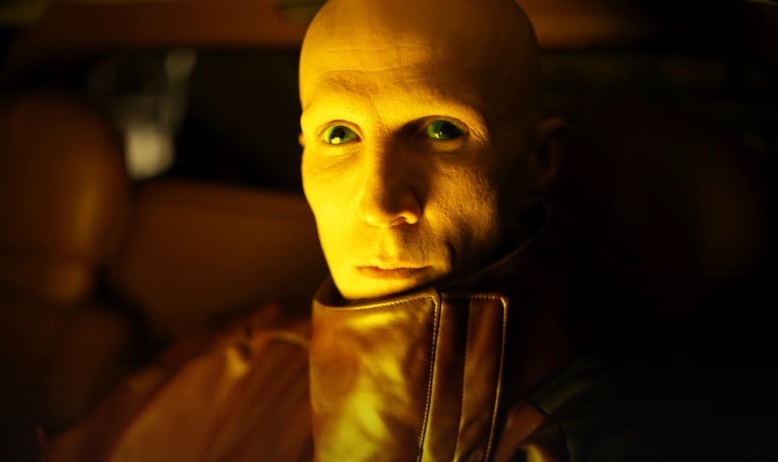
Finally, what about the acting? Michael J Rogers certainly nails it with his Dr. Nyle performance. His monotone line delivery, blank, comatose stares and pasty, android-like features make him “made for the movie.” Eva Bourne (as Elena) has really no opportunities to showcase her talent. She mostly just sits, slumped in a chair, lies on a table, or walks from place to place. Since she is a mute, she doesn’t even say anything (with one exception I will discuss in the next paragraph). While Eva may be an excellent actor, she has no opportunity to show it here. Elena could have been played by just about anyone with the same success, when such little is required. Sometimes, an actress can be outstanding as a mute, when facial expressions are all the more important and exceptional. But, again, the character of Elena, as she is scripted, also has none of that. Basically, her requirements were sit down, slump, lie down, walk around…and Eva Bourne does all of that like a pro. I would now like to see Bourne in some of her many other movies. (She has quite a filmography on IMDb.) Additionally, Scott Hylands has a small but integral part as Dr. Mercurio Arboria, the founder of the Arboria Institute. Appearing only in a vintage commercial for the institute in the beginning, and one scene later, Hylands, unlike Bourne, still manages to be memorable.
You’re nothing. You’re less than nothing. Just…spit in the wind.” ~ Dr. Nyle
And now for the next paragraph about the exception to Elena’s muteness. She does say something one time. However, unless you have the subtitles turned on at this point, you will not know what it is. And what she says is something very important! I found out long ago that subtitles can sometimes translate the inaudible…and sometimes the inaudible is essential. You will know this scene, when Elena’s head begins pulsating, in some seemingly inter-dimensional spatial anomaly. If you don’t have the subtitles on yet, it’s time!
Beyond the Black Rainbow is definitely worth checking out! While it may not become a favorite or one you’ll watch again, it will keep your attention for it’s nearly two-hour running time–1h 50m to be exact. While it slow-burned, or smoldered, ever so slowly to its end, I never checked the time even once. And that’s why I’ll recommend Beyond the Black Rainbow to anyone still reading. If you’ve read my review this far, you’re interested!
“Your mother’s reabsorption into the cycle of life won’t be for nothing, my darling Elena. You will be the dawning of a new era for the human race and the human soul.” ~ Dr. Mercurio Arboria
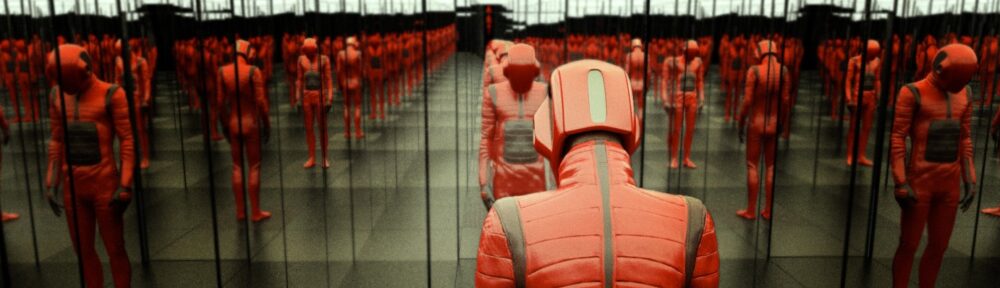
Will Dr. Nyle find the answers to the cosmic mysteries of the universe and, perhaps, become a god himself? Will Elena escape from the deranged doctor and finally experience the dangerous world called Earth and its dangerous inhabitants called humans? Is Elena better off staying in a prison, protected from the evils outside? Will we ever know what Dr. Nyle’s research is all about and the plans he has for Elena? Will we ever know Elena’s origins, who her parents are, the extent of her powers, and if she is a god herself? What are the android-like beings, dressed in red, with baby faces and mouths agape? And, maybe most importantly, why is the rainbow black? For swirling psychedelic mindscapes and acid-trip retro worlds, complete with 80s elevator music and a plot that leaves most to the imagination, watch Beyond the Black Rainbow…and find out! And remember, in the words of the immortal Buckaroo Bonzai, “No matter where you go, there you are.”

Rocket Rating – 7
Chris Rennirt (the author of this review) is a movie critic and writer in Louisville, Kentucky, as well as editor in chief at Space Jockey Reviews. He has been a judge at many film festivals, including Macabre Faire Film Festival and Crimson Screen Film Fest, and he attends horror and sci-fi conventions often. Chris’ movie reviews, articles, and interviews appear in Effective Magazine and are published regularly on Space Jockey Reviews. His mission statement (describing his goals as a movie critic and philosophy for review writing) can be found on the “Mission” page, here at SJR. For more information about Chris Rennirt (including contact details, publicity photos, and more), click here.